Listen to this article
Every drummer hits the same wall eventually. You’ve had your kit for a year, maybe two. You’ve gotten decent. And now you’re staring at it, wondering why it doesn’t sound like the drummers you watch on YouTube.
The instinct at this point is to start Googling “best snare drum” or “best cymbals” and buying whatever has the most five-star reviews. I want to talk you out of that, because I’ve made that mistake myself, and I’ve watched a lot of students make it too.
Here’s the order that actually matters, based on what genuinely changes how your kit sounds versus what just makes you feel like you bought something.
Start With Heads, Every Single Time
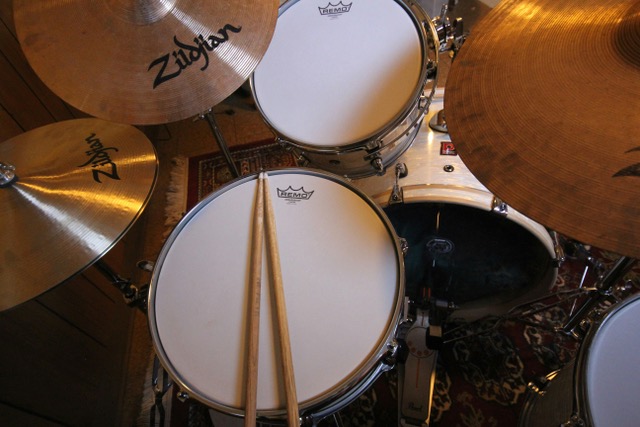
If you take nothing else from this article, take this: your drumheads are doing more work than you think, and they’re the cheapest fix on this entire list. Most kits, even decent intermediate ones, ship with heads that were chosen to keep the manufacturer’s costs down, not to make your drums sound their best. A stock head is rarely a bad head, but it’s rarely the right head for what you’re trying to do.
Swap a thin, single-ply stock head for a proper two-ply coated head like an Evans G2 or a Remo Ambassador, and you’ll hear a difference within the first three hits. Your toms will stop ringing out into nothing. Your snare will have a body instead of just a crack. The part nobody tells you is that the resonant head matters just as much as the batter head, sometimes more. I’ve had students replace their batter heads, hear an improvement, and stop there, leaving a blown-out or overly thin resonant head doing nothing for them. If you’re only changing one side, you’re leaving tone on the table.
Budget for this: somewhere between sixty and a hundred and fifty dollars, depending on your kit size. It’s, without exception, the best dollar-for-dollar upgrade available to you.
Then Cymbals, Because They’re Half of What People Actually Hear
Once your drums sound right, look at your cymbals. This is where I see intermediate players hesitate the most, usually because good cymbals are genuinely expensive and it feels like a bigger commitment than swapping a head.
Here’s the thing, though. In a mix, in a room, in a recording, cymbals are doing an enormous amount of the sonic lifting. A crash that sounds thin and clangy will undercut an otherwise great-sounding kit faster than almost anything else. If your cymbals came stock with an entry-level kit, there’s a very good chance they’re brass, and brass cymbals simply can’t produce the complexity and shimmer that bronze alloys can.
You don’t need to replace everything at once. Start with your hi-hat, since you’ll spend more time playing on it than any other cymbal in your setup, and a muddy or one-dimensional hi-hat will frustrate you in every single song. After that, your ride. Crashes can wait a little longer because you’re hitting them far less often.
This is the upgrade that requires patience and saving, but it’s also the one that will make the biggest difference to anyone listening to you play, whether that’s an audience, a bandmate, or a microphone.
Hardware Comes Last, and That’s Okay
I want to be honest about something most gear guides won’t tell you: hardware upgrades feel great and matter the least for your actual sound. A sturdier hi-hat stand, better cymbal stands, and a proper throne; these things absolutely improve your playing experience. They make setup faster, they hold their position through a hard gig, and a good throne will save your lower back over years of practice.
None of that changes your tone. If you’re choosing between a new ride cymbal and a fancy new snare stand, the ride wins every time for sound. The one exception worth flagging is your kick pedal. A cheap, stock pedal can genuinely limit your technique, especially as you start developing speed and dynamic control. If your foot feels like it’s fighting the pedal instead of working with it, that’s worth addressing sooner rather than later.
A Quick Word on Snares
I left this out of the main order on purpose because it depends entirely on your kit’s starting point. If your snare shell is genuinely poor—thin metal, badly cut bearing edges—no amount of head swapping will fully fix it.
But for most intermediate kits, the snare shell itself is usually fine. It’s the head and the tuning that are holding it back. Fix those first before you spend real money on a new snare. You might find you didn’t need one after all.
If you’re working with a genuinely budget-tier kit and want a more complete breakdown of where to focus first, this guide on making a cheap drum set sound great from The Drum Ninja covers the same philosophy applied to entry-level gear, and it’s a good companion read if your starting point is a bit further back than where this article assumes.

The Honest Bottom Line
Nobody wants to hear this, but the order that actually changes your sound is rarely the order that feels the most exciting to buy. Heads are unglamorous. Most people skip straight to dreaming about a new snare or a flashy cymbal pack.
But if you follow this order, heads, then cymbals, then hardware, with snares evaluated honestly along the way, you’ll spend your money in the place that actually moves your sound forward, instead of the place that just feels like progress. Your ears will tell you the difference—they usually do.
Diego Cardini is a writer, performer, and educator based in Buenos Aires, Argentina. He started drumming at 12 and played in numerous bands, going through several musical styles. He currently runs thedrumninja.com, a drumming resource for drummers of all levels.
 Francis' Drumming Blog