In this new episode, we explore the Samai Thaqil, a rhythm originating and used in traditional belly dance music, adapting it to the drumset. “Belly dance” is a Western umbrella term encompassing various dance styles originating from countries in the Middle East, North Africa, Eastern Europe (the Balkans), and Mediterranean Sea areas. The accompanying music features a diverse array of intriguing rhythms. Traditionally, these rhythms use percussion instruments like the bendir, a type of frame drum, and the darbuka; this hourglass-shaped goblet drum is the primary percussive instrument for belly dance.
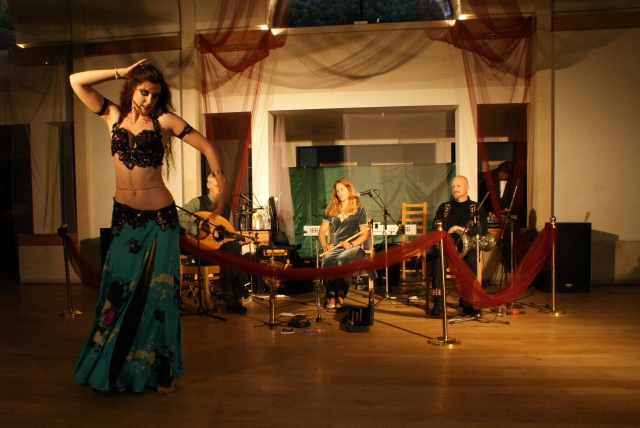
Many popular belly dance songs have fairly straightforward structures, though some incorporate complex odd meters. In particular, classical Turkish music has contributed to the rhythmic diversity. These uneven rhythm patterns, consisting of groups of two and three notes, are known as “aksak,” which means “limping” in Turkish. Their irregular subdivisions make them fascinating and enjoyable to play, offering contemporary drummers a rich source of inspiration!
Introduction
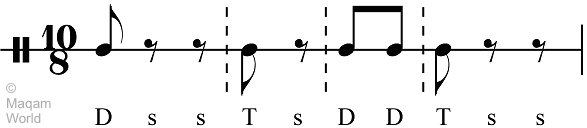
The Samai Thaqil is a classical 10/8 rhythm of Ottoman-Turkish origin, very popular among belly dancers for slow sections. The Arabic variation of this rhythm is also known as “Sama’i Thaqil.” You can hear Samai in Muwashah music (or muwashshah) for the musical accompaniment of poetic texts, in the megeance (the first song of the belly dancer’s show), classical Middle Eastern music, and drum solos. The name “Samai Thaqil,” translating to “heavy Samai,” underscores its elaborate and weighty feel, distinguishing it from other rhythmic patterns. This rhythm has transcended centuries, rooted deeply in the Ottoman classical music tradition, maintaining its relevance and continuing to captivate audiences with its sophisticated interplay of beats and pauses. As a cornerstone of the Samai musical form, it provides a rhythmic foundation for expressive melodic and harmonic exploration, making it a favorite among composers and performers dedicated to preserving and innovating within the realm of Arabic music.
Drumset Adaptation
In replicating the Samai Thaqil on the drumset, we arrange each percussion part to capture the authentic feel of the rhythm. The main groove is in 10/8 and is subdivided as 3+2+2+3, performed at a slow tempo. The bass drum replicates the “doum,” while the snare emulates the “tek” part, as illustrated in the figures below that compare the percussion and drumset notation. The “slap” (sharp, pronounced sound) is orchestrated on the hi-hat, establishing a steady 8th-note pattern.

Additional Resources
Here is a selection of tracks to listen to in this style of music.
You can hear Samai rhythm in various musical genres, from jazz to psychedelic rock and funk. Here is an application of this rhythm by the German band Karl Hector & The Malcouns. Elevate your drumming!
Notes and References
- Van Rompaey, Ruben. “Belly Dance Rhythms for Drumset.” Modern Drummer, September 2018.
- Zuhair, Zahra. “Bellydance A-Z.” Zahra Zuhair’s Bellydance Blog, May 18, 2016. https://glitteringglimpses.wordpress.com.
- Maqam World (Unknown Author). “Iqa‘ Sama‘i Thaqil 10/8.” Maqam World. https://www.maqamworld.com/en/iqaa/samai_thaqil.php.
 Francis' Drumming Blog
Hello,
I’m looking for a tab of eminence front by the who.
Have you got it?
Thanks
Olivier
LikeLiked by 1 person
Hi,
No, it’s not available for now!
However, you can find Behind Blue Eyes:
https://francisdrummingblog.com/2020/01/25/the-who-behind-blue-eyes-drum-sheet-music/
All the best,
Francesco
LikeLike