In the previous lesson, I shared some exercises to master quintuplets.
Quintuplets Drum Lesson 1
Here’s the first part of a series of lessons on 16th-note quintuplets, a group of five notes in the space of a quarter note. We start with a…
Read moreIn this second lesson, I show you a system to play and interpret the exercises of Ted Reed’s Syncopation (pages 38 to 45) in 16th-note quintuplets with an alternate sticking (RLRLR, LRLRL).
What we’ll do is read the pages of Reed’s Syncopation in 16th-note quintuplets, similarly when you play in 8th-note triplets or 16th notes. Since these pages are based on 8th notes, the possible accent combinations will be two: on the downbeat (first note of the quintuplet) or on the upbeat (fourth note). A good preliminary exercise is to play all the accent combinations: downbeat, upbeat, and both, as shown below.

Once comfortable (don’t forget the bass drum or the hi-hat in quarter notes), go to page 38. Before you start, be sure to know how to read Ted Reed’s Syncopation in 8th-note triplets and 16th-notes.
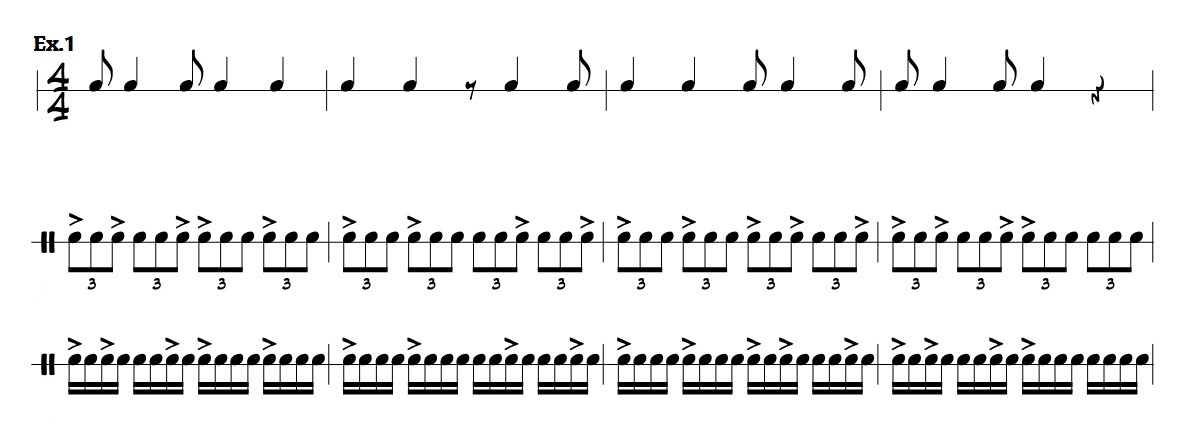
Here’s how the first four bars of exercise one should be played.

In modern drumming, 16th-note quintuplets are often incorporated both in a groove and solo context, becoming part of the vocabulary of drummers like Matt Halpern, George Kollias, Anika Nilles, Jeff Hamilton, Greg Hutchinson, and many others. Take your time, quintuplets need constant work to be mastered. Remember to start slow and apply all the concepts of this and the previous lesson on the drumset. Keep on drumming!
 Francis' Drumming Blog